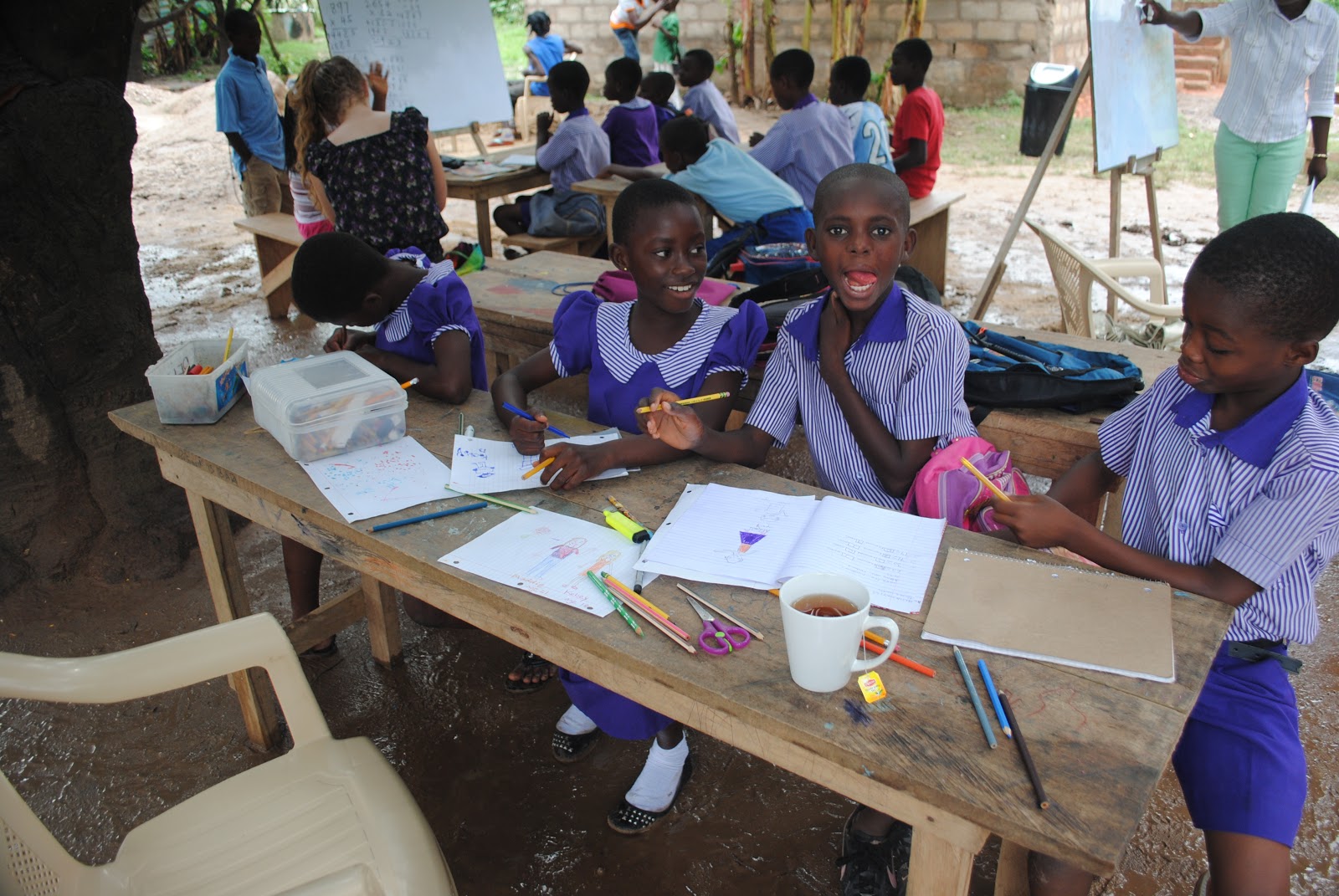
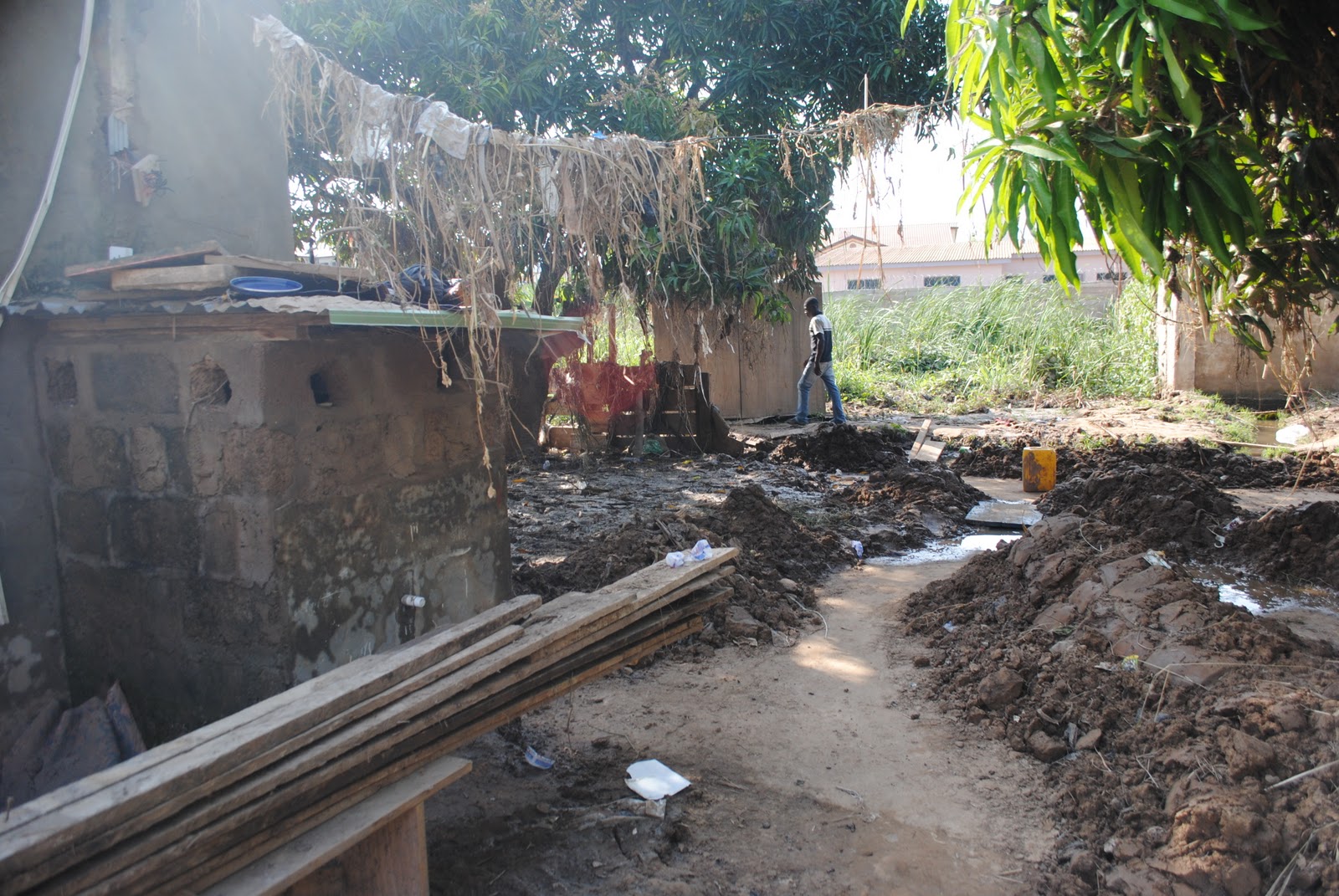
Yesterday I brought my camera to school for the first time for no particular reason. Unfortunately, though, it was one of those days were very few students come to school because it had rained hard the night before. Since only four out of my fifteen-ish students showed up, I decided to try doing more hands-on things that were hard to do with lots of kids. We started the day by reading a story with first grade, then we drew pictures of our families and labeled each member with their name and age. We ended the day with a science lesson about climates, and I had students come up to the board to circle different words like “penguin” and “mango” with different colors to show what climate they belonged to.
Even though there were so few kids, it actually ended up being a good day to take pictures to show what school is like when it rains. I imagined writing a blog post about it to point out the difficulties the school faces with bad weather, but I had no idea then that those weather problems were NOTHING compared to what would happen only several hours later. So, there went that blog post, and here’s a much more noteworthy one:
A little over a week ago, a 19-year-old Californian came to volunteer at GGYN for a few months. He’s been planning this trip since Mollishmael spoke at his high school years ago, so yeah, he’s a pretty incredible person. Anyway, Mollishmael has wanted to have volunteers over to the school for dinner for a while now, and last night Fernando made a big dinner of these delicious lettuce-wrap things. It was a pretty last-minute get together, so several people who had been hoping to go couldn’t because their dance exam went too late. Being someone who rarely turns down free food, though, I headed over for what I thought would be a little bit, but it started pouring while I was there. Since the school office has bunk beds for volunteers to use and I didn’t want to have to wait for a cab, I decided to just spend the night and head back in the morning.
However, these plans changed quite a bit. I went to bed around one a.m. and woke up about an hour later to a stranger handing me my bag, saying, “The water is rising; we have to leave.” Obviously I was confused to say the least, but I looked around and saw everyone else packing bags and heading out into the pouring rain. I followed, got to the door and stopped: since the electricity at the school had been out for a few days, all that I could see were faint reflections of the moon on seemingly endless water. It was actually pretty beautiful, but the rain was only getting worse and the flood was nearly at the door’s threshold. I stepped into the water and carefully headed down the stairs that were no longer visible. When I had reached the ground, the water was literally at my waist. I pushed through the flood as fast as my jeans would allow me to go and walked through the gate and onto the path.
At this point the water was only to my knees, but navigating here was tough: the narrow, uneven and winding path drops off into a steep “gutter” on one side and into grasses and bushes on the other. Of course, the flood made the dirt path both treacherously slippery and completely invisible. I slipped a bit once, so the stranger who woke me up grabbed me by the arm and led me to the street where my friends were huddled under the awning of a small store. I’m still not sure who that guy was, but one thing that I’ve encountered many different times at this school is that there are so many people who, like him, will do extraordinary things to help out virtually anyone. We waited by the store while Siza (Mollishmael’s brother who’s teaching me to paint) and some other strangers went back to the school to grab as many important things as they could, then we headed to the intersection down the street to wait for a taxi under another awning.
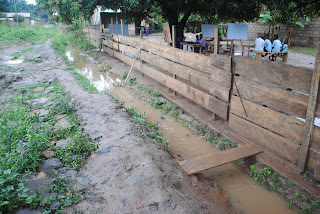 |
| What the path looks like on a normal day. The gate leads into the schoolyard. |
When we reached this storefront, I was surprised to see several students of the school standing there with their parents. They were all soaked and wearing no more than what they would normally wear, so we put our arms around them to keep them (and us) warm. It’s really hard to say how long we were waiting there (maybe 30 minutes or more?) until we got a cab. I piled in the cab with five or six other people, four of whom were kids, and we headed to where my friend Karen lives with her dad and brother. Siza and Mollishmael walked from the school and met Fernando, the kids and me at the house. Karen gave all of us clothes of hers to wear for the night and we hung up our wet things to dry. We all scattered on couches, beds and cushions on the floor throughout the house and finally headed back to sleep probably sometime around 4 a.m.
I woke up before seven this morning to find that Mollishmael and Siza had both gone back to the school to assess the damage and grab any other important things that had survived the night. I spent an hour or so entertaining the kids (we cut snowflakes out of toilet paper!) until the two returned. Luckily enough, I had arbitrarily left my camera on an upper bunk where it had stayed safe all night, so I had it to take pictures this morning. The only things that I lost were a cheap watch from Walmart, my room key (but I happen to have a spare), and my flip-flops. It turns out that the two-year-old, Fernando and I were the only three who weren’t smart enough to grab our shoes when we left, but Mollishmael insisted on buying us new sandals before we went anywhere.
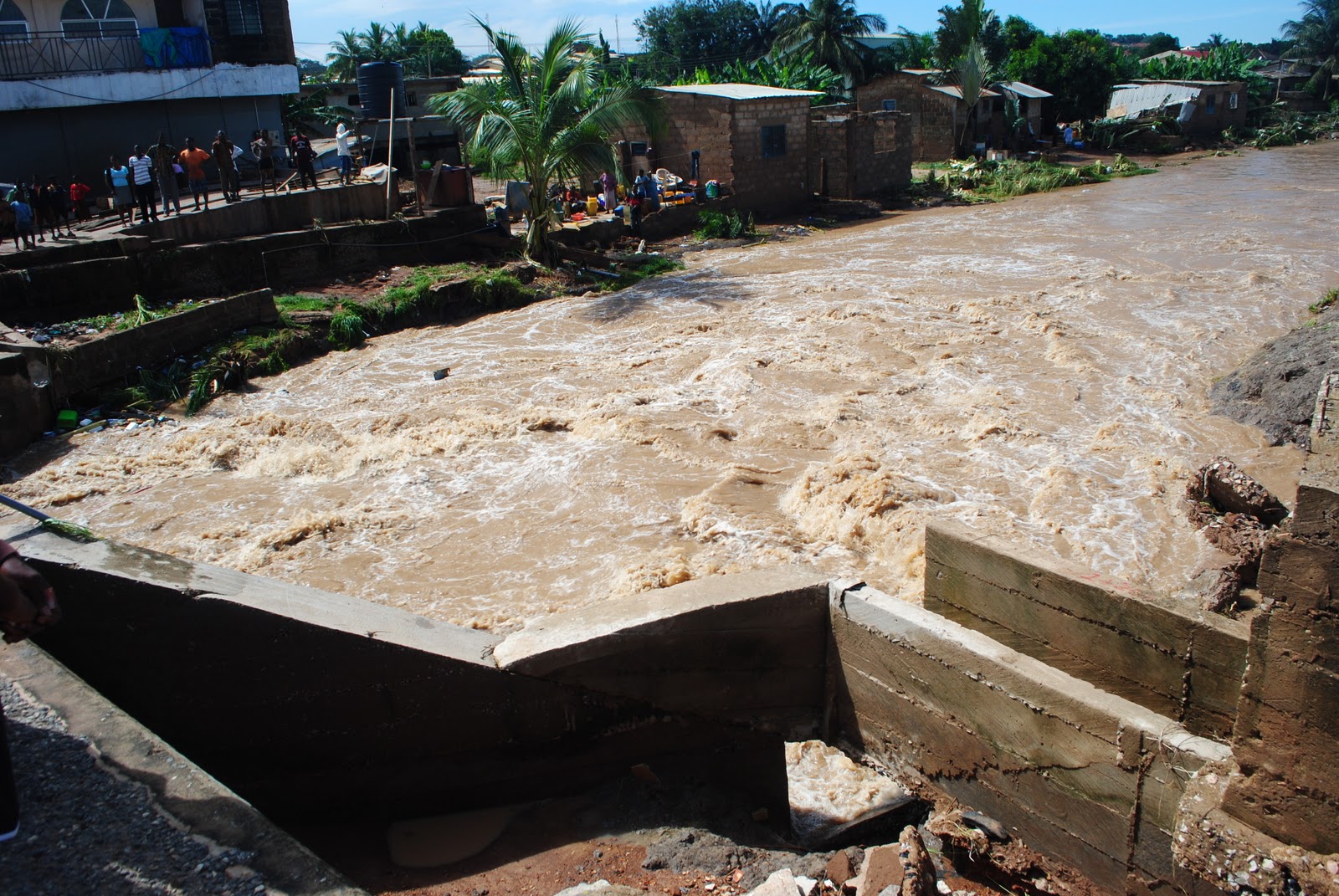
The walk from Karen’s to the school was pretty devastating: the stream was now a raging river, mud was everywhere, and there were even small houses overturned and sheds thrown in the middle of the street. We couldn’t get all the way to the school because it was still so flooded and muddy. I had class this morning at 9:30 and was already late at this point, so we got into a cab to get back to Karen’s quickly. However, within two minutes we were dead stopped in traffic. We got out so we could just walk, but it turns out that traffic had been stopped for a pretty interesting reason: the president of Ghana, John Atta Mills, had come by apparently to see the damage from the flood. Not many people seemed happy to see him, though, I guess because the government had not paid attention to the area’s regular flooding problems until such a severe instance.
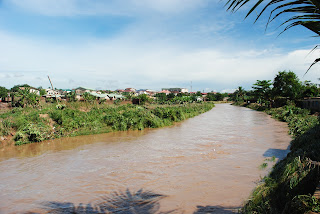 |
| The stream by the school that makes the flooding so terrible. It's normally a fraction of this size. |
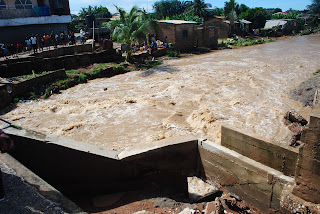 |
| A view of the stream from the other side of the bridge. |
 |
Community members observing the change in the stream's size.
|
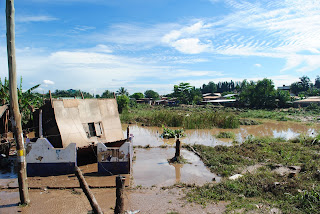 |
| An overturned house near the stream. |
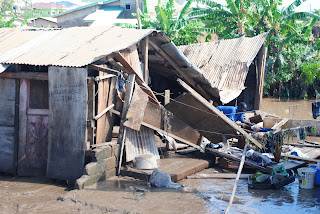 |
| Damage from the rain. |
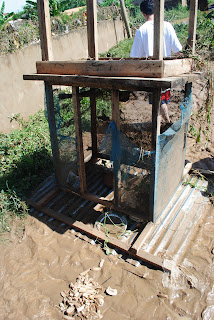 |
| Upside-down food stand. |
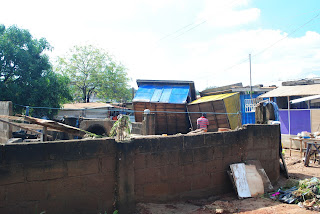 |
| More over-turned houses. |
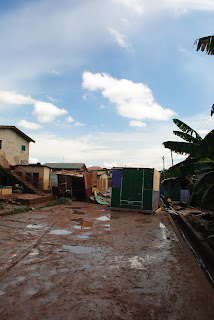 |
There isn't supposed to be anything in this street. These sheds are small stores that are normally on the side of the road where you can see some other buildings.
|
|
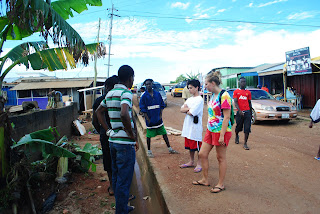 |
We ran into Katie (on right) when we went to go see the school. She's studying abroad with my program and teaches at the school, too. Fernando's in the white shirt and Mollishmael's in the blue hoodie.
|
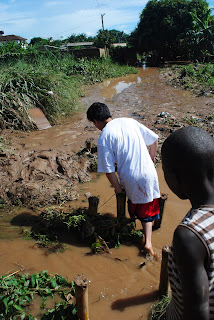 |
Fernando, Katie and I tried to get close to the school with a random boy who was hanging out nearby.
|
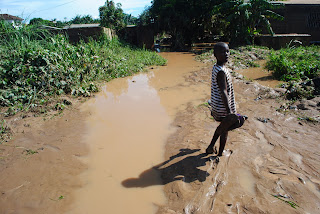 |
| This is about as far as we could get toward the school until we decided that the water was just not safe to walk through. This is the path leading to the school, and the school is in the distance to the right. |
 |
Siza (pronounced like Caesar) was responsible for getting us up and out of the school and he also saved tons of important documents and electronics. We decided that he's today's hero, and this is apparently his hero pose.
|
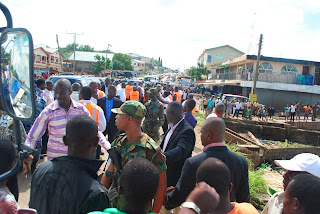 |
| President John Atta Mills is in the white and pink shirt behind the guy in the purple stripes on the left. After I took this picture someone told me to put away my camera or the guards might take it. |
When we eventually got back to Karen’s, she had gotten together a bucket of water, soap and a towel for me to wash all of the mud off of myself (the house, like the one at the school, doesn’t have running water), and our excellent hostess also made all of us breakfast. While we ate, Mollishmael told us that when he had gone back early to go to the school, he saw the kids’ parents with the other people who we had left under the awning when we got the cab during the storm; none of them had left that spot all night because they had no where else to go.
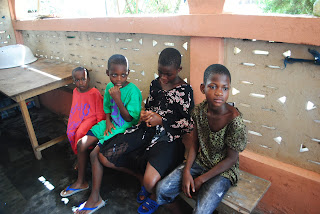 |
| The kids who stayed at Karen's with us, all dressed in Karen's clothes. Left to right: Dennis (age two?), Kobby (age 9), Princess (age 11), and Prencilla (age 9). Kobby, Princess, and Prencilla are siblings. |
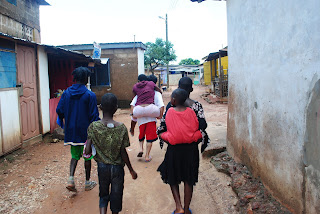 |
| Leaving Karen's house in the morning. Princess was carrying Dennis and Karen said she was jealous, so Fernando gave Karen a lift, too. |
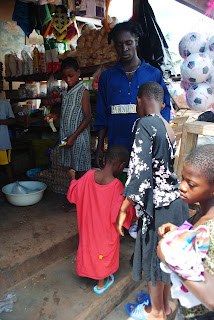 |
| Buying Dennis shoes. |
 |
| Princess and Dennis. |
I eventually made it to my class about an hour and a half late, clad in ill-fitting gym clothes and still fairly muddy. I’m exhausted now, but I’m so glad that I got to experience the sort of struggle that has really been putting this school back. I’m not sure how much has been destroyed or when school will resume again, but I’m hoping to go back as soon as possible to start help cleaning things up. I’ll try to keep the blog updated on what happens next.